

Behind the Scenes: The Night of the Key
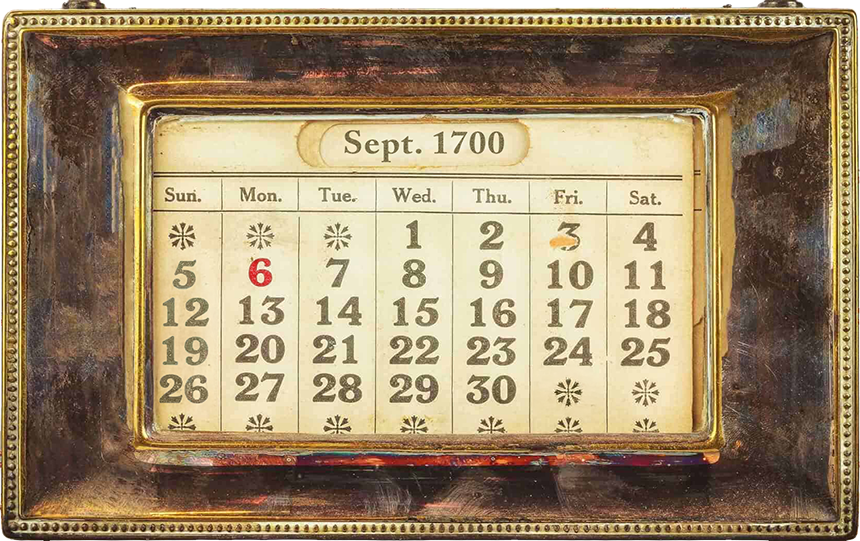
Set the Wayback Machine to Sep 6, 1700
What I call “The Incident of the Key” and the events leading up to it make up the bulk of Chapter 23 of La Maupin, Mistress of the Sword. It has proven to be one of the most “researchable” sections of the book.
As context, it happens while d’Albert is on the run from the law after his duel with two foreign counts over which of them can claim Madame de Luxembourg for his mistress. At the same time either his brother or possibly the two of them together were engaged in helping their sister run away from her husband and the Duke of Savoy, who had made her his mistress. Sources like Sourches, Saint-Simon and du Noyer have written about both of these.
Then there’s the “Incident of the Key” itself—her assault and battery on her landlord and his cook, for refusing to provide her and her “sister” with supper after they returned from the theatre. Gabriel Letainturier-Fradin’s account of the incident in his 1904 book, La Maupin (1670–1707), cites what he says are the actual reports, including witness statements, made by Commissaire Jean Regnault. These reports indicate that La Maupin had just returned from the theatre, and there are quite a few sources available today on just what performance she might have returned from.
Finding all of these resources and weaving them into a credible story has been both a lot of work and a lot of fun.
Just the facts, Madame
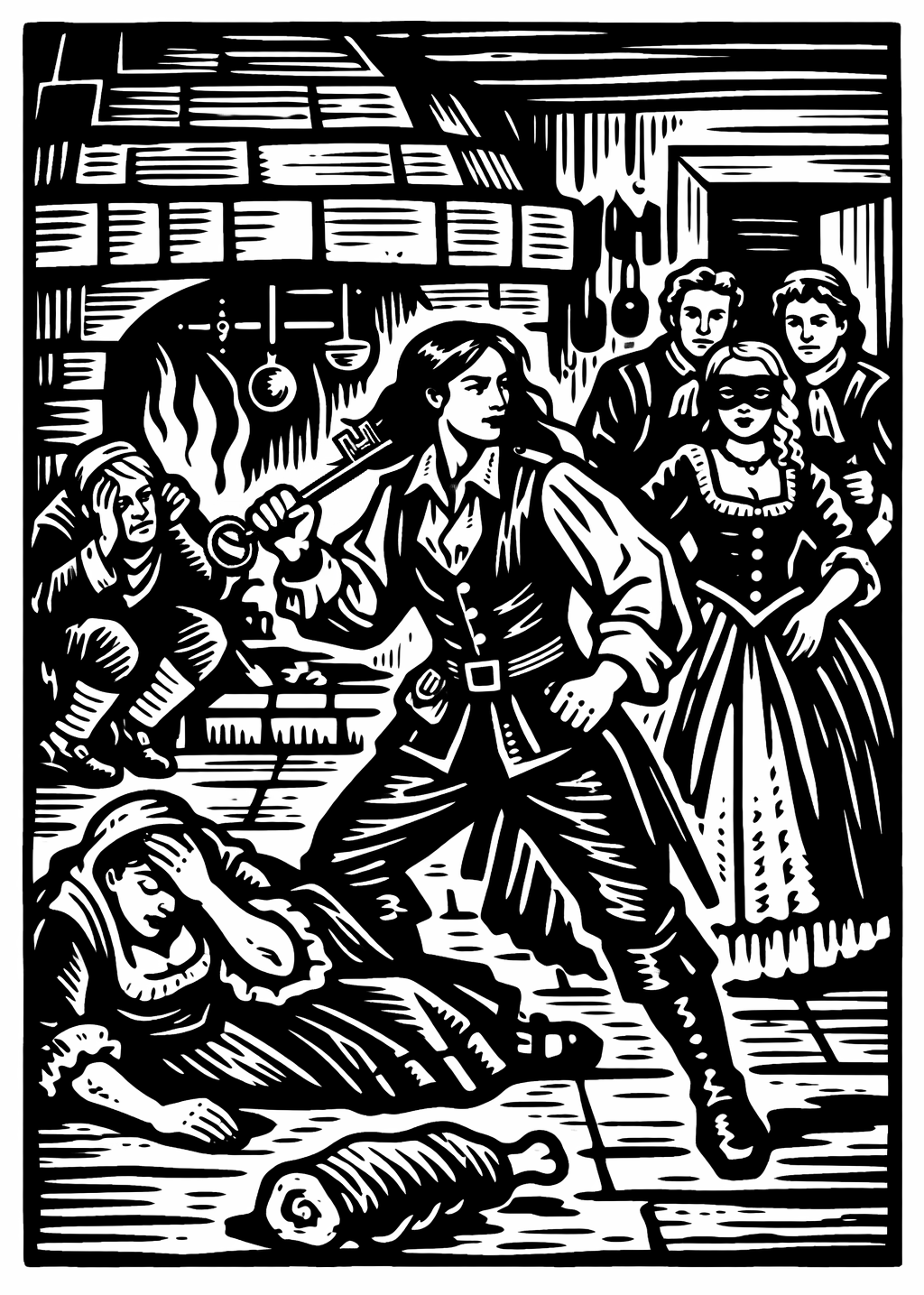
Incident of the Key (AI).
To start with, Jean Regnault was an actual commissaire and the French National Archives do have copies of his reports. Fradin kindly gives us the document retrieval ID for them. While they are not available on-line, starting with that ID, and the information that he published from them, I was able to request scanned versions from the archives. They can be found both as images and side-by-side transcriptions and translations done using a combination of ChatGPT and Google’s Gemini, hand-checked by me, on my page “The Key: Jean Regnault’s files”. Fradin's original versions, with translations, can be found on the “Is It True?: The Affair of the Key” page.
The complaint
Here is a somewhat modernized version of Regnault’s report, taken from his files. A more literal translation, as well as the witness statements and a report from the surgeon summoned to the scene can be found in the pages mentioned above.
On September 6, 1700, at 9:30PM, we, Jean Regnault, Esq., having been urgently summoned, went to Traversière Street, to the house kept and occupied by Sieur Langlois, bourgeois of Paris. Upon entering the house, directly into a kitchen just inside the main doorway, we found Marguerite Fourré, servant of Sieur Langlois, wounded on the forehead above the right eye.
Her white linen headdress, trimmed with lace, was torn into pieces, and her grey cloth garment was marked with blood in several places on the front. She told us and formally lodged a complaint against the woman named Maupin, singer at the opera, her sister, with three unknown lackeys.
She stated that Maupin, having come down from her room into the kitchen and asked for supper, Sieur Langlois told her that he was no longer obliged to give her food, on account of a bad incident that had occurred between them. Whereupon Maupin, angered, in a fit of rage took one of the cuts of mutton she (Fourré) was roasting on the spit and struck Sieur Langlois with it. Sieur Langlois having stepped aside, the blow from the mutton struck the door instead.
Then, taking the large key of the door in her hand, Maupin struck the complainant on the head, wounding her so that she bled and suffered an open wound above the right eye. Thereafter she threw herself upon her, accompanied by her sister and her lackeys, knocked her down onto the kitchen hearth, gave her several kicks and blows with fists, and tore her headdress and her face, as we see her now.
For these reasons, the complainant requested us to receive the present complaint in order that an inquiry might be made, and she signed the summons against Maupin.
The witnesses
From Regnault’s report, we learn about several more people, both witnesses and people from their households. Adding them to those mentioned in the original report, we have the following:
| Langlois | Maupin’s landlord |
| Marguerite Fouré | Langlois’s cook |
| Mlle. Maupin | Opera singer; Langlois’s tenant |
| “Sister” | Supposed sister of Maupin |
| Two or three lackeys | Servants of Maupin or her sister |
| Rabier | Master tailor; Langlois’s neighbor |
| René Mérot | Tailor, Rabier's employee |
| Marquise de Vances | Langlois’s neighbor |
| Verand Raphaely | Valet to Mme de Vances |
| Michel Bauchet | Master saddler; Langlois’s neighbor |
| Marie Soufflart | Michel Bauchet’s wife |
| Marie-Anne Bauchet | Michel Bauchet’s daughter |
| Desportes | Surgeon; summoned to treat Fouré |
Here are slightly modernized versions of the witness reports. Again, more literal translations can be found on the two pages mentioned above.
The Tailor: Sieur René Mérot
The next morning the magistrate heard the first witness, Sieur René Mérot, a tailor working for Master Tailor Rabier on Rue Traversière, parish of Saint-Roch.
Hearing a commotion from my master’s house, I stepped outside and noticed it was coming from the house of Sieur Langlois, where Maupin and her sister resided. I saw her sister at the first-floor window, speaking to someone at another window across the street. She said, “My sister (speaking of) Maupin, had the large door key.” At that moment, I also learned that the said Maupin had cracked the complainant’s head with a blow from the large key to the door of the house where she resided.
The Valet: Verand Raphaely
The second witness was Sieur Verand Raphaely (or "Rafely"), valet to the Marquise de Vances, who lived near La Maupin’s residence.
Hearing noise from my mistress’s house, I stepped outside and saw that the commotion was in the neighboring house, of Sieur Langlois. Entering, along with several others, into a kitchen to the right of the main entrance, I saw Maupin, singer at the Opera, sprawled on the kitchen floor, grappling with the complainant by the hair. They were separated; the complainant, once on her feet, was bleeding above the right eye. I picked up two torn pieces of lace from Maupin’s (sic) headdress and returned them to her. Someone forced Maupin to withdraw, though she made several attempts to re-enter. The injured complainant said that Maupin had struck her with the large key to the carriage door of the house.
The Saddler’s Wife: Marie Soufflart
The third witness was Marie Soufflart, wife of Master Saddler Michel Bauchet, who had rushed to the scene with her daughter upon hearing the noise.
I heard the disturbance in Maupin’s residence and went there with my daughter. Entering the kitchen, I saw several people—men, women, and lackeys, some dressed in red and gray—whom I recognized as from a neighboring house. Through them, I glimpsed the complainant, disheveled and being held by the hair, though I could not tell by whom. I later heard that she had been injured on the head.
The Saddler’s Daughter: Marie-Anne Bauchet
Marie-Anne Bauchet, her daughter, gave a similar statement.
She testified that on the previous evening, from her parents’ shop, she heard a commotion in Sieur Langlois’s house and went there with her mother. Upon entering the kitchen to the right, she saw the servant—whom she later learned was named Fourré—disheveled and being mistreated by hand. She did not see who was striking her but noticed that she had been knocked to the ground in the kitchen, and was then helped up. The witness withdrew shortly after learning that Fourré had suffered a head wound, with bleeding and an open wound.
The Surgeon’s Report.
The final witness was the surgeon who was summoned to treat the cook. His medical report was as follows:
I, the undersigned, surgeon to the King and sworn master in Paris, certify to all whom it may concern that on September 6, 1700, between nine and ten in the evening, I was called to examine, treat, and medicate Marguerite Fouré, servant to Sieur Langlois, residing at Rue Traversière. I found a wound on her forehead, extending to the coronal bone, about a finger’s width across, penetrating to the periosteum. Additionally, there was a contusion and bruising on her left forearm, along with multiple pains reported in different areas of her body. These injuries appear to have been caused by a blunt, edged instrument, such as a candlestick, a key, or something similar. To prevent dangerous complications such as fever or abscesses, I prescribed strict rest, confinement to bed, and medical treatment twice daily. If no complications arise, the wound should heal within fifteen days. This I certify as true. Given in Paris, the 7th of this month and year above.
(Signed) Desportes
Now playing at the Comédie Française
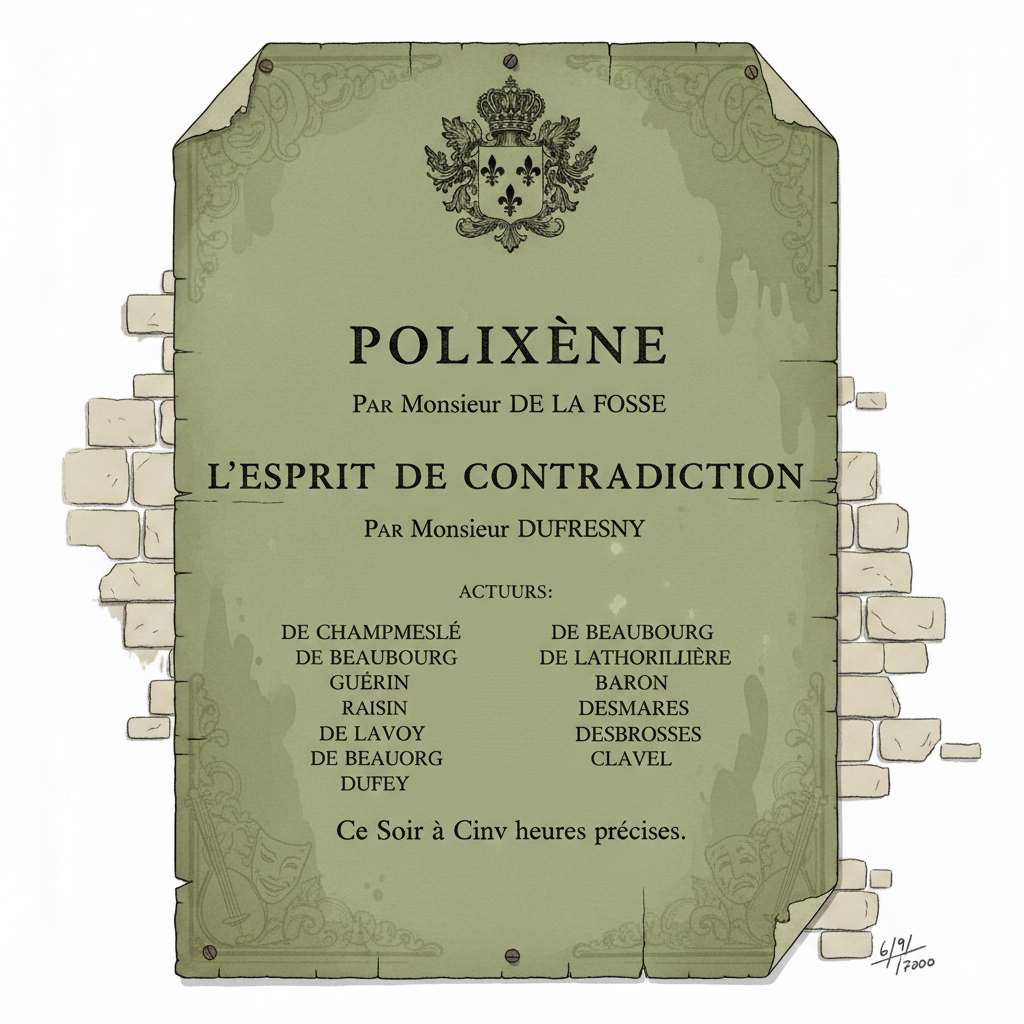
AI imagined poster for the night.
Fradin’s account says “After the evening’s performance, around nine o’clock on 6 September 1700, La Maupin went home as she usually did, and then went down to the kitchen to ask for supper.” But what performance was she returning from? Generally, the Théâtre de l’Académie Royale de Musique did not perform on Mondays. Their usual schedule was Sunday, Tuesday, & Thursday. On the other hand, the Comédie Française performed almost every night. So, perhaps she and her “sister”, accompanied by two or three lackeys, had just come back from attending the theatre, rather than from performing at the Opéra.
Typically, the Comédie Française performed two plays each night, a long-form tragedy followed by a short comedy. Much of their repertoire was classics, and a different play was put on every night. When a new play debuted, though, it would be performed repeatedly over a few weeks. So, what specifically would our heroines have gone out to see?
As it turns out, the ledger books of the Comédie Française are available on their website, so if they did attend la Comédie, we can reconstruct a few details.
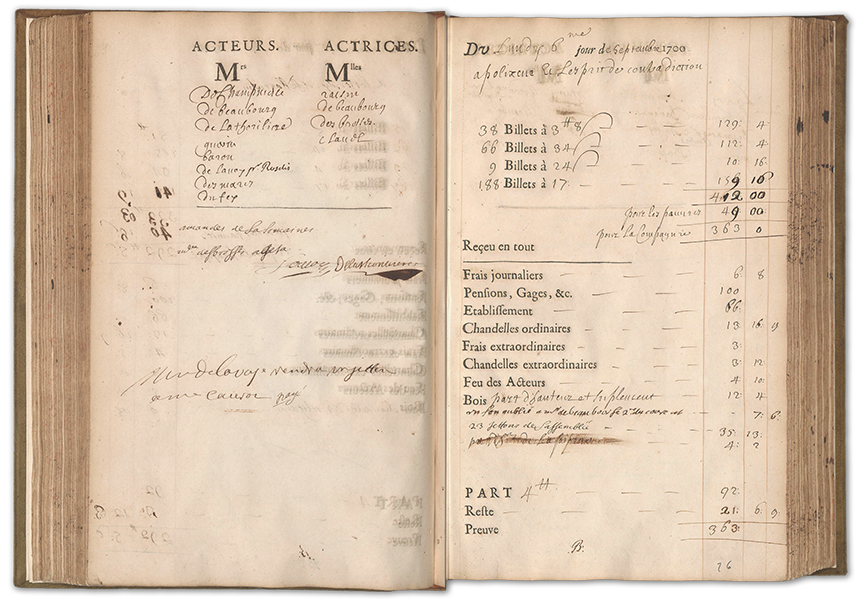
Comédie Française register/ledger for September 6, 1700 from cfregisters.org
Image CC BY-NC-SA 3.0 Bibliothèque-Musée de la Comédie-Française.
Used by permission.
At the top of the righthand page, we learn that on Monday, September 6, 1700, there were performances of Polixene and L’esprit de Contradiction. Examining the other August and September entries, we find that Contradiction had premiered on August 27, and played roughly every other day through September 19, paired with a different tragedy each night.
| Item | Amount (Livres : Sols) |
| 38 Billets à 3lt 8s | 129 : 4 |
| 66 Billets à 34s | 112 : 4 |
| 9 Billets à 24s | 10 : 16 |
| 188 Billets à 17s | 159 : 16 |
The entries in the preprinted section at the top of the righthand page give us the number of tickets (“billets”) sold for the first, second and third tier boxes and the “pit” (the “parterre”). Using this, we can determine how busy a night it was at the theatre and how likely it is that La Maupin could get a box at the last minute, especially one with a privacy-protecting latticework, as I had her do.
The total box-office for September 6 was 412₶ (412 livres). Looking back, the premiere of L’esprit de Contradiction brought in 1151₶ : 6s and the second performance 1354₶ : 10s. The play was a hit. By a week later attendance had dropped off such that there were considerably more boxes available (38 first tier tickets as opposed to 164 on August 29th). Preserving the identity of La Maupin’s “sister” seems much easier, and the show is clearly something Julie might have wanted to see. What more can we say about it?
| ACTEURS. Mrs |
ACTRICES. Mlles |
|---|---|
| De Champmeslé | Raisin |
| De Beaubourg | De Beaubourg |
| De Lathorilliere | Desbrosses |
| guérin | Clavel |
| baron | |
| De Lavoy pr Roselis | |
| Desmares | |
| Dufey |
The list of players at the top of the lefthand page covers the actors and actresses who appeared in either play, with no indication of which roles they played and in which plays. Still, we can make some educated guesses. L’esprit de Contradiction played repeatedly, following a different tragedy, mostly set in classic times. On the sixth, it was Polixene, set at the end of the Trojan War.
If we compare the lists of performers in the 10 evenings of the run, we can separate the ones who are there every night that L’esprit de Contradiction was on the bill. Adding to that what kinds of roles the various actors were known for and looking at the order of players in both the lists and the cast listing of the play, we can even make pretty good guesses at who played each role.
.png)
AI portrait of La Raisin after unknown engravers.
Our best guess is that, on the sixth, the cast was M. Desmares, Mlle. Raisin, M. La Thorillière, Mlle. Clavel, M. Étienne Baron, M. Guérin, M. Beaubourg and M. Lavoy, with M. Lavoy having taken over the rôle played by M. Roselis after the first four performances and Mlle. Clavel standing in for Mlle. Desbrosses who was said, in a note on the lefthand page, to be absent from this one.
Mlle. Raisin, whom we’ve cast as the female lead for the comedy (and quite possibly the tragedy as well), is an interesting character in her own right. She was born Françoise “Fanchon” Pitel de Longchamp in 1662 and was a founding member of the Comédie-Française, shortly after marrying Jean-Baptiste Raisin, an actor known as “le petit Molière”. They had 8 children by the time he died in 1693. After that, she became the mistress of Monseigneur, le Grand Dauphin, son and heir to Louis XIV and grandfather of Louis XV. La Raisin and the Dauphin had three daughters by the time of this performance.
Four players have no roles in the comedy and so must have appeared in the tragedy. We can start with them and match them to the sort of character they are likely to play and then try to work out which actors match the remaining roles and are likely to have been in both plays. Our confidence in this casting is a little lower than for the comedy. Still, I end up with enough information to be able to have Maupin make plausible references.